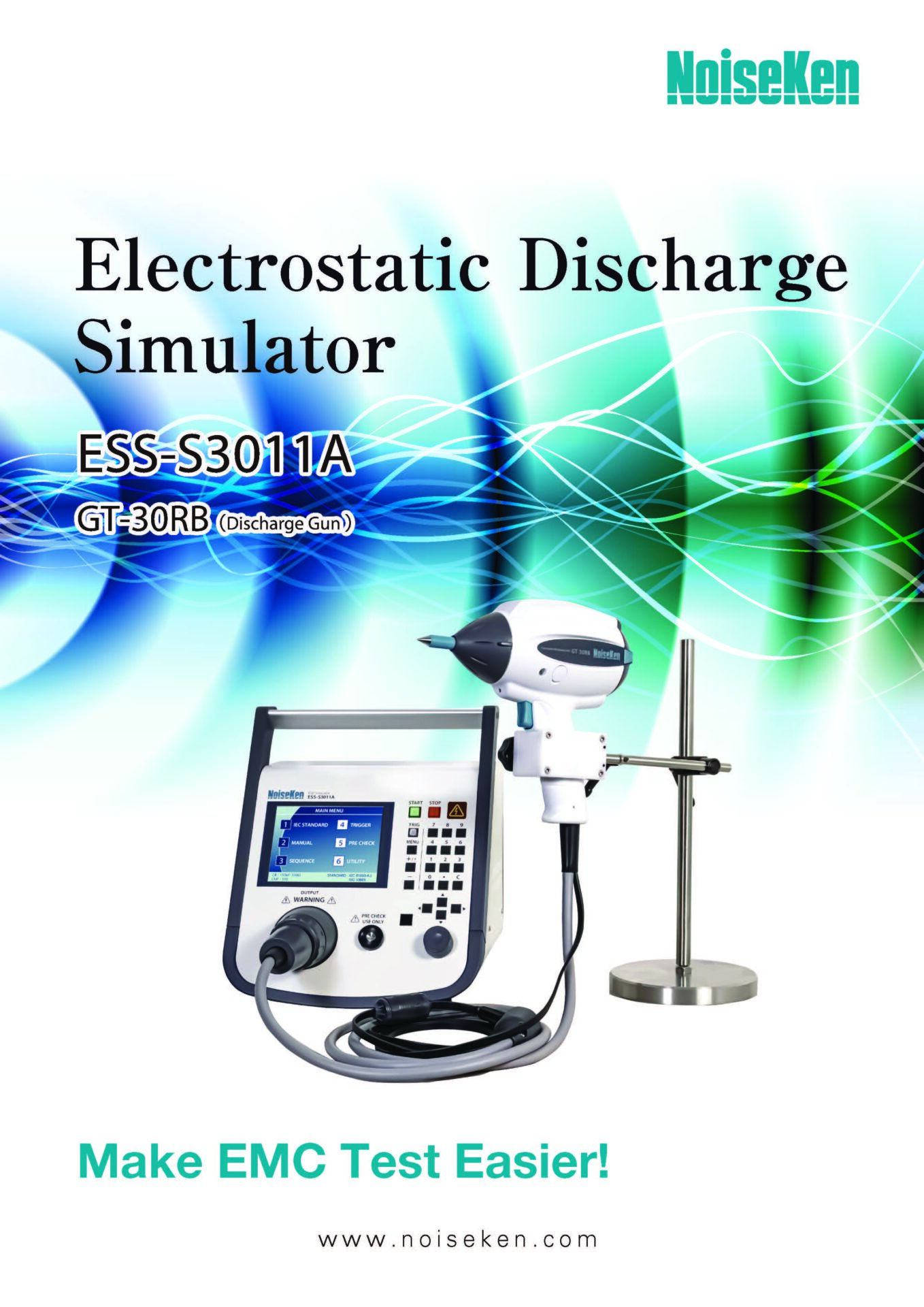
Standard Information ISO 10605 Ed.3 Standard Overview
NoiseKen1. General
Electrostatic discharges which are generated both in vehicles and while we get on and off there can be factors to cause malfunction of the electrical devices and components. Nowadays, more attention has been paid, as vehicles install more and more electronic devices and components. This Standard regulates that static electricity is discharged to the electronic devices or equipment from the charged human body and tests are simulated by electrical circuit to reproduce the electric current waveform at the discharge.
In addition to procedures for the immunity tests and evaluations in state that the electronic devices or equipment work while the vehicle is driving, the Standard also regulates tests procedures to evaluate the immunity of the each module against simulated human discharges during the assembly process or in servicing.
2. Test levels
The following tests levels are for reference. The categories are classified according to functional importance of the electronics devices/components.
Component test – Example severity levels for direct contact discharge and direct air discharge (Function performance status)
| Test level | Direct contact discharge | Direct air discharge | ||||
| Category 1 | Category 2 | Category 3 | Category 1 | Category 2 | Category 3 | |
| Level 4 | ±8kV | ±8kV | ±15kV | ±15kV | ±15kV | ±25kV |
| Level 3 | ±6kV | ±8kV | ±8kV | ±8kV | ±8kV | ±15kV |
| Level 2 | ±4kV | ±4kV | ±6kV | ±4kV | ±6kV | ±8kV |
| Level 1 | ±2kV | ±2kV | ±4kV | ±2kV | ±4kV | ±6kV |
Component test – Example severity levels for indirect contact discharge (Function performance status)
| Test level | Indirect Contact Discharge | ||
| Category 1 | Category 2 | Category 3 | |
| Level 4 | ±8kV | ±15kV | ±20kV |
| Level 3 | ±6kV | ±8kV | ±15kV |
| Level 2 | ±4kV | ±4kV | ±8kV |
| Level 1 | ±2kV | ±2kV | ±4kV |
Component test — Packaging and handling — Example severity levels —
| Test level | Direct contact discharge | Direct air discharge | ||||
| Category 1 | Category 2 | Category 3 | Category 1 | Category 2 | Category 3 | |
| Full function after test | ±1kV | ±2kV | ±4kV | ±8kV | ±15kV | ±25kV |
Vehicle test — Example severity levels for contact discharge and air discharge (Test points accessible only from inside vehicle)
| Test level | Contact Discharge | Air discharge | ||||
| Category 1 | Category 2 | Category 3 | Category 1 | Category 2 | Category 3 | |
| Level 4 | ±6kV | ±8kV | ±8kV | ±8kV | ±15kV | ±15kV |
| Level 3 | ±4kV | ±4kV | ±6kV | ±6kV | ±8kV | ±8kV |
| Level 2 | ±2kV | ±2kV | ±2kV | ±4kV | ±4kV | ±6kV |
| Level 1 | – | – | – | ±2kV | ±2kV | ±4kV |
Vehicle test — Example severity levels for contact discharge and air discharge (Test points accessible only from outside vehicle)
| Test level | Contact Discharge | Air discharge | ||||
| Category 1 | Category 2 | Category 3 | Category 1 | Category 2 | Category 3 | |
| Level 4 | ±6kV | ±8kV | ±8kV | ±15kV | ±15kV | ±25kV |
| Level 3 | ±4kV | ±6kV | ±6kV | ±8kV | ±8kV | ±15kV |
| Level 2 | ±2kV | ±2kV | ±4kV | ±4kV | ±6kV | ±8kV |
| Level 1 | – | – | ±2kV | ±2kV | ±4kV | ±6kV |
3. Specification of generator and verification of output waveform
■ Specification of ESD simulator
A simulator satisfying the following specifications must be used for the ESD Testing.
| Parameter | Specification |
| Output voltage – Contact discharge- (kV) | 2kV~15kV |
| Output voltages – Air discharge- (kV) | 2kV~25kV |
| Output voltage accuracy (%) | ≦ 5% |
| Polarity | Positive and negative |
| Rise time of short circuit current in contact discharge mode (10% to 90%) | 0.7ns~1ns |
| Holding time | ≧ 5 s |
| Storage capacitances (pF) | 150pF,330pF |
| Discharge resistances (Ω) | 2kΩ,330Ω |

For air discharge at test voltages higher than 15 kV, a larger tip can be used to avoid pre-discharge.
■ ESD Simulator Characteristics (Contact discharge mode current specifications)
The following discharge characteristics must be verified.


4. Verification of test generators and waveforms
■ Check output current waveform
The waveform shall be verified with an oscilloscope which bandwidth is 1 GHz or more in a Faraday cage or with a 1.2 m × 1.2 m metallic board mounting an ESD current target in the center of the cage or the board. The discharge electrode (Discharge tip of the gun) shall be touched onto the target and the discharge mode shall be set at the contact discharge mode.
The discharge return cable shall be turned up the center of the length and connected to vertically 0.5 m under the target on surface of the Faraday cage or board.

■ Current Target calibration
The frequency characteristics of current waveform observation targets must be verified using a dedicated measurement jig.

Adaptor for calibrating ESD current target(Model:06-00068A)

Figure of attaching ESD current target and the calibration adaptor (Left : Target Right : Adaptor)

5. Test Setup
■ Common Points:
・Ground plane: at least 1.6 x 0.8m in size, at least 0.2m larger than the DUT or peripherals during setup, and with a connection resistance of 2.5mΩ or less.
・Insulating block: height 50±5mm. Extend 20mm beyond the test configuration on all sides.
・The DUT shall be connected to all peripheral devices required for functional testing of the DUT with the wire harness length of 1.7m (+0.3m – 0).
・All components should be at least 0.2 m apart from each other.
・Bundle the wire harness 0.1m away from the edge of the ground plane and secure it to the insulating block.
・The supply battery shall be on the test table, with the negative terminal of the battery directly connected to the GP.
・The test stand should be at least 0.1m away from other dielectric structures.
・For direct discharge, connect the electrostatic simulator’s discharge return cable to the ground plane.
・Use discharge network of 150pF or 330pF depending on the EUT device location, and use 330Ω or 2kΩ.
・The test should be conducted for two or more test levels.
・Insulating block should be used for electronic equipment that are not directly chassis-mounted.
■ Component immunity test method (powered-up test) – Direct contact and air discharge –
・Test at least 3 times with positive and negative polarity, separated by at least 1 second.
・Apply to every location available for human touch.
・Insulating block should be used for electronic equipment that are not directly chassis-mounted.
【 Contact Discharge 】
・The discharge electrode is brought into contact with the discharge point of the DUT before activating the discharge switch.
・For painted surfaces, if the coating is not an insulating coating, the pointed tip of the generator should penetrate the coating so as to make contact with the conducting substrate.
・The ESD discharge tip is held perpendicular to the surface of the DUT.
【 Air Discharge 】
・After operating the discharge switch, move the discharge electrode tip to the DUT as quickly as possible (0.1m/s to 0.5m/s) until it contacts the discharge point and apply voltage.
・If the conductive material is declared to be an insulating coating, perform air discharge.

■ Component immunity test method (powered-up test)
– Indirect Discharge –
・Apply discharge to the ground plane with contact discharge.
・Test 10 times or more at intervals of 1s or more.
・Apply to the ground plane at points on each side of the DUT.
・Position the DUT so that the nearest surface is 0.1 m away from the edge of the ground plane that receives the discharge.
・Apply at a position 0.1m from the DUT and harness.
・Select 330pF as the CR constant depending on the mounting position of the device, and use 330Ω.

■ Component immunity test method (powered-up test)
– Indirect Discharge using FCP –
・Test at least 10 times with positive and negative polarity at intervals of for at least 1 second.
・The CR constant is selected to be 150pF or 330pF depending on the mounting position of the device, and 330 Ω is used.

■ Component immunity test method (unpowered)
- Packaging and Handling – ESD Sensitivity Test
・Test at least 10 times with positive and negative polarity to each island, at intervals of for at least 1second.
・CR constant is 330 pF depending on the mounting position of the device, and 330 Ω is used.

■ Component immunity test method (unpowered)
- Packaging and Handling – ESD Sensitivity Test
・We recommend using a CR constant of 150 pF and conducting tests with resistances that simulate both direct human contact (2 kΩ) and contact with a metallic object being held (330 Ω).
・Conduct tests of two or more levels.
・At least 3 discharges shall be applied both to the positive and negative polarities with the interval not less than 1s.
・Contact discharge is applied to all areas touched by the hand.
・After applying the voltage, remove the static electricity from the DUT with a static elimination resistor of 1MΩ±20%, then energize it and confirm that it operates normally.

■ Vehicle test – Internal and external points –
・Areas that can be easily touched by people inside the vehicle are tested with 330pF/330Ω or 2kΩ.
・Areas that can be easily touched by people from outside the vehicle are tested with 150pF/330Ω or 2kΩ.
・The ground wire connects to the chassis, such as the seat rail. During external testing connect to a nearby chassis or metal plate under the tire.
・Both the contact discharge and air discharge tests shall be done both for the internal and external tests.

Note: This test outline is based on the ISO10605 Ed.3 2023 Standard. Please refer to the original text of the Standard for detailed test methods, etc.